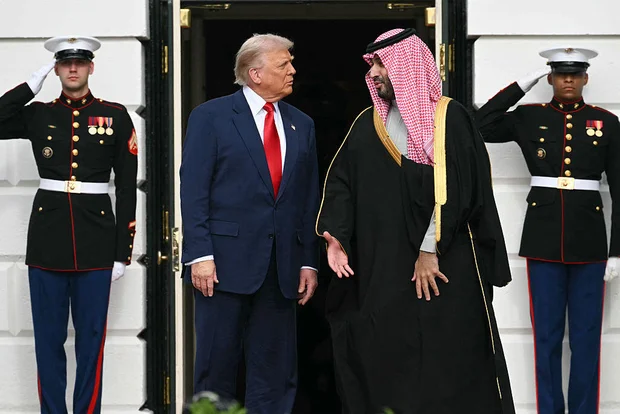
In 18 November 2025,
the Washington meeting between former US President Donald Trump and Saudi Crown
Prince Mohammed bin Salman (MBS) at the White House marked a significant
recalibration in US-Saudi relations. It was MBS’s first official visit to
Washington since the 2018 killing of journalist Jamal Khashoggi, an episode
that had cast a long shadow over bilateral ties. The optics of the visit: a
state-like reception, military flyover, and a formal dinner attended by leading
US technology executives, signalled a renewed strategic convergence built on
defence, capital flows, and emerging technologies.
At the core of the
meeting were major transactional outcomes. Washington approved the sale of up
to 48 F-35 fighter jets, making Saudi Arabia the first Arab state to acquire
the advanced platform. This decision upgrades Riyadh’s qualitative military
edge. In parallel, MBS pledged to expand Saudi investment in the United States
from an already substantial US$600bn towards US$1 trillion, including US$20bn
earmarked for AI and data-centre infrastructure. Civilian nuclear cooperation
also advanced, with discussions reportedly encompassing uranium enrichment
rights, which is an issue with long-term non-proliferation implications.
The meeting occurred
amid heightened regional tensions and intensifying global competition in
artificial intelligence. For Washington, Saudi capital injections into AI
infrastructure are strategically valuable as the United States seeks to
consolidate its lead in high-performance computing and semiconductor-driven
innovation. Silicon Valley’s renewed engagement with Gulf sovereign wealth,
despite reputational sensitivities after Khashoggi, underscores the
gravitational pull of Saudi liquidity in a capital-intensive AI race. For
Riyadh, such investments align with Vision 2030 objectives to diversify beyond
hydrocarbons and position the Kingdom as a technology and logistics hub
bridging Asia, Europe, and Africa.
Regionally, Trump
pressed for Saudi accession to the Abraham Accords, but MBS reiterated that
normalisation with Israel requires a credible pathway to Palestinian statehood.
This conditionality reflects domestic, regional, and Islamic political
considerations. While positioning himself as a potential mediator on Gaza,
Syria, Lebanon, and even Iran-related de-escalation, MBS is simultaneously
hedging: deepening US ties while maintaining robust economic and technological
engagement with China and preserving secondary defence relationships, including
with Pakistan. The result is a more assertive Saudi Arabia pursuing strategic
autonomy rather than exclusive alignment.

However, limits
remain. A full US-Saudi mutual defence treaty appears uncertain, particularly
given congressional sensitivities. Likewise, absent tangible progress on
Palestine, Riyadh is unlikely to take the political risk of formal
normalisation with Israel. The nuclear file also raises questions: granting
enrichment capabilities could recalibrate regional security dynamics and
complicate global non-proliferation norms.
For Bangladesh, the
implications are multidimensional. A stronger US-Saudi alignment may reshape
Middle Eastern power balances that directly affect Bangladeshi migrant workers
and remittance flows, which are both critical to Dhaka’s macroeconomic
stability. Saudi mega-projects in infrastructure, airports, and AI-driven
sectors could generate fresh demand for skilled and semi-skilled Bangladeshi
labour. Conversely, heightened regional militarisation or nuclear competition
could increase indirect risks to diaspora communities.
Economically, expanded
Saudi investment in US technology ecosystems may create downstream
collaboration opportunities in AI, ICT, and data services, which are areas
where Bangladesh is gradually building capacity. Diplomatically, Dhaka will
need to navigate a shifting triangular dynamic among Riyadh, Washington, and
Beijing with prudence. Any future Saudi movement on the Abraham Accords could
also alter Organisation of Islamic Cooperation politics, influencing
Bangladesh’s longstanding position on Palestine.
This Trump-MBS meeting
signals a pragmatic, interest-driven reset. It reinforces Saudi Arabia’s
emergence as a pivotal middle power leveraging capital, energy, and
geopolitics, while pointing to a US approach that privileges strategic
transactions over normative conditionality. For smaller states such as
Bangladesh, the evolving alignment requires calibrated engagement to mitigate
risks and capture opportunity.