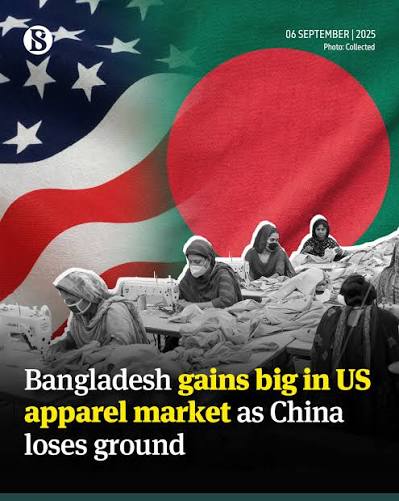
1. Introduction: The Apparent Shift and Its Complications
In the first two months of
2026, U.S. Office of Textiles and Apparel (OTEXA) data revealed a seismic shift
in the global apparel supply chain: Bangladesh exported $1.37 billion worth of
garments to the United States, surpassing China, whose exports plummeted by
57.65% to $1.17 billion [1]. Vietnam maintained its dominant position with $2.7
billion in exports [1]. On the surface, this data suggests a decisive victory
for Bangladesh, seemingly validating the hypothesis that U.S. tariffs on
Chinese goods have successfully diverted trade to South Asia.
However, a rigorous methodological examination reveals significant complications. The apparel industry is characterized by extended production lead times, complex global value chains, and structural path dependencies. Analyzing a two-month snapshot in isolation risks conflating temporary order reallocations with sustainable structural shifts. This paper critically reassesses the OTEXA data by disaggregating the temporal dimensions of the trade shift, reverse-engineering the production timeline, and comparatively analyzing the structural resilience of Bangladesh, China, and Vietnam. The central argument posits that Bangladesh's apparent rise is a "false dawn"—a statistical artifact of market contraction and temporal bias rather than a sustainable, tariff-induced structural advantage.
2. Trade Diversion and Its Temporal Dimensions
The theoretical framework of
trade diversion, originally articulated by Jacob Viner, suggests that
discriminatory tariffs (such as the U.S. Section 301 tariffs on China) will
shift sourcing from more efficient producers (China) to less efficient, but tariff-exempt,
producers (Bangladesh or Vietnam) [2]. To test this theory empirically, one
must establish clear temporal delineations to isolate the tariff shock from
pre-existing trends.
- 1. The Pre-Tariff Baseline
(January–July 2025): The period before the finalization and
implementation of the reciprocal U.S.-Bangladesh tariff regime and the
escalation of U.S. tariffs on Chinese apparel.
- 2. The Post-Tariff Transition
(August–December 2025): The immediate aftermath of the policy shock,
during which buyers began adjusting their sourcing strategies.
- 3. The OTEXA Data Period (January–February 2026): The current snapshot, which reflects the physical arrival of goods ordered during the transition period.
Without this temporal disaggregation, any causal link drawn between the 2025/2026 tariff policies and the January-February 2026 export volumes is methodologically flawed.
3. The Production Timeline Problem: Reverse-Engineering the Causality
The most critical methodological flaw in attributing the January-February 2026 OTEXA data to recent tariff policies is the failure to account for the apparel production timeline. The global apparel supply chain operates with significant lead times, typically ranging from 14 to 26 weeks from order placement to U.S. port arrival [3]. When we reverse-engineer this timeline, a stark reality emerges:
- • Goods arriving in January-February
2026 were physically manufactured between October and December 2025.
- • The raw materials (fabric, yarn)
for these goods were procured between August and October 2025.
- • The actual sourcing decisions and purchase orders were finalized by U.S. buyers between June and August 2025.
Therefore, the sourcing decisions reflected in the January-February 2026 data were made before the full implementation of the late-2025 tariff escalations.
- • Pre-Tariff Period (June-August 2025): During this period, buyers were already shifting orders away from China due to anticipated risks, but the formal tariff structures were not yet fully operational. Bangladesh was capturing overflow orders based on its existing low-cost capacity, while Vietnam was securing high-value orders.
- • Post-Tariff Period (Late 2025):
As tariffs formalized, buyers accelerated their exit from China. However, the
goods ordered during this period will not appear in OTEXA data until Q2 or Q3
of 2026.
- • OTEXA Period (Jan-Feb 2026): The current data reflects the anticipatory shifts made in mid-2025, not the reactionary shifts to the finalized tariff regime. Thus, attributing Bangladesh's rise strictly to the finalized tariffs is a temporal fallacy.
4. Historical Trends: Bangladesh's Pre-Tariff Ascendancy
To further isolate the tariff effect, we must examine the historical baseline. Was Bangladesh already ascending before the tariff shock?
Data from early 2025 indicates that Bangladesh was already experiencing significant growth. In the first quarter of 2025, Bangladesh's apparel exports to the U.S. grew by 26.64% year-on-year, significantly outpacing the overall market growth [4]. This pre-tariff ascendancy was driven by structural factors: Bangladesh's massive capacity in basic cotton garments, aggressive pricing strategies by local manufacturers recovering from domestic disruptions, and a generalized "China Plus One" strategy that predated the specific late-2025 tariff hikes.
Therefore, the January-February 2026 data represents a continuation of a pre-existing trajectory rather than a sudden, tariff-induced inflection point. The tariffs acted as an accelerant to an existing trend, not the primary catalyst.
5. China's Decline: Tariff-Driven or Structural?
The 57.65% decline in China's
exports to the U.S. in early 2026 is staggering, but attributing it solely to
U.S. tariffs oversimplifies a complex structural transformation.
China's share of U.S. apparel imports has been steadily declining for over a decade, dropping from nearly 40% in 2010 to under 20% by 2024 [5]. This structural decline is driven by China's deliberate industrial upgrading. As Chinese wages rose and the state prioritized high-tech manufacturing (EVs, semiconductors), low-margin apparel assembly was systematically offshored often by Chinese firms themselves to Southeast Asia and Bangladesh.
While the U.S. tariffs undoubtedly accelerated the exodus of apparel orders, they largely formalized a structural shift that China had already initiated. The 57.65% drop reflects both the punitive tariff environment and China's strategic pivot away from the sector.
6. Vietnam's Growth: Why is it Immune to These Shocks?
While Bangladesh and China
experience volatile shifts, Vietnam remains remarkably stable, exporting $2.7
billion in early 2026 [1]. Vietnam's immunity to these shocks is rooted in its
structural superiority and strategic positioning.
Unlike Bangladesh, which relies on low wages ($0.60-$1.30/hour) and basic cotton garments, Vietnam competes on efficiency, technology, and product complexity [6]. Vietnamese workers are approximately 65% more efficient, and factories utilize advanced automation, neutralizing Bangladesh's wage advantage [7]. Furthermore, Vietnam has successfully transitioned to higher-value Man-Made Fiber (MMF) apparel, commanding higher unit prices.
Crucially, Vietnam is insulated by a robust trade architecture, including 15+ Free Trade Agreements (FTAs) and deep Foreign Direct Investment (FDI) integration [8]. This FDI-driven model provides Vietnam with capital, technology, and global buyer relationships that Bangladesh lacks. Consequently, when U.S. buyers leave China, the high-value, complex orders flow to Vietnam, while the low-margin, high-volume overflow goes to Bangladesh.
7. Market Contraction as a Confounding Variable
The final, and perhaps most
critical, methodological nuance is the overall state of the U.S. apparel
market. The narrative of Bangladesh's "rise" obscures a fundamental
paradox: Bangladesh achieved the number two position while its actual export
volume declined by 8.53% year-on-year [1].
This occurred because the overall U.S. apparel import market contracted by 13.47% during the same period [1]. Bangladesh did not grow its exports; it simply shrank slower than China. This is a relative victory in a contracting market, not an absolute gain in competitiveness.
When market demand recovers, buyers will prioritize suppliers with speed, efficiency, and complex product capabilities-areas where Vietnam excels and Bangladesh lags. Therefore, celebrating Bangladesh's rise to the number two spot based on a two-month snapshot in a shrinking market is a dangerous false dawn. Without structural reforms particularly in MMF backward linkage, automation, and FTA negotiations ahead of its 2026 LDC graduation, Bangladesh's apparent advantage will evaporate as quickly as it materialized.
References
[1] U.S. Office of Textiles and
Apparel (OTEXA). "U.S. Imports of Textiles, Apparel, Footwear, Leather and
Travel Goods: January-February 2026." U.S. Department of Commerce, April
2026.
[2] Viner, J. The Customs Union Issue. Carnegie Endowment for International Peace, 1950.
[3] Gereffi, G., & Frederick, S. "The Global Apparel Value Chain, Trade and the Crisis: Challenges and Opportunities for Developing Countries." World Bank Policy Research Working Paper, 2010.
[4] Sheng Lu. "Patterns of U.S. Apparel Imports: Updated January 2026." FASH455 Global Apparel & Textile Trade and Sourcing, 2026.
[5] Lu, S. "Why China Remains the Unrivaled King of Apparel Manufacturing." Just-Style, 2024.
[6] AKCN. "China vs Vietnam vs Bangladesh: Clothing Manufacturing Cost & Quality Comparison." January 2026.
[7] Texasia. "10 Keys Difference Bangladesh vs Vietnam Apparel Industry." August 27, 2025.
[8] OECD. "OECD Economic Surveys: Viet Nam 2025." Harnessing Trade and Investment Flows to Boost Productivity, 2025.