
Bangladesh Institute of International and Strategic Studies
Bangladesh Institute of International and Strategic Studies
U.S.-Bangladesh Relations on 27 May 2013
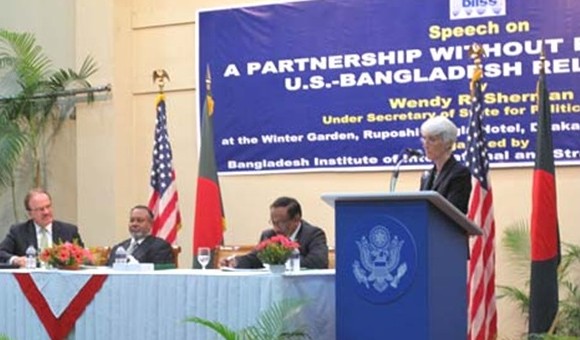
The Bangladesh Institute of
International and Strategic Studies (BIISS) organised a Special Lecture
titled "A Partnership without Boundaries: U.S.–Bangladesh
Relations" on 27 May 2013 at the Winter Garden, Ruposhi
Bangla Hotel, Dhaka.
H. E. Ambassador Wendy R.
Sherman, U.S. Under Secretary of State for Political Affairs,
delivered the keynote speech as the Guest Speaker. Mr Md Shahidul
Haque, Foreign Secretary, Ministry of Foreign Affairs, Government of the
People's Republic of Bangladesh, delivered the welcome address. H. E. Dan
Mozena, U.S. Ambassador to Bangladesh, made the introductory remarks, while
Ambassador Munshi Faiz Ahmad, Chairman of the Board of Governors, BIISS,
chaired the session and delivered the concluding remarks.
In her address, Ambassador
Wendy R. Sherman reaffirmed the United States' strong commitment to further
broadening, deepening, and strengthening its partnership with Bangladesh. She
described the bilateral relationship as one founded on shared values, mutual
respect, and common strategic interests, and emphasised the importance of
expanding cooperation across political, economic, security, and development
sectors.
The Guest Speaker underscored the
significance of an inclusive democratic process, stressing the
importance of free, fair, and credible elections in strengthening
democratic governance. She also highlighted the need for continued reforms in
Bangladesh's industrial sector, particularly in improving workplace safety,
labour rights, and the living standards of workers following recent industrial
challenges.
Ambassador Sherman praised
Bangladesh's outstanding contribution to United Nations Peacekeeping
Operations, recognising the country's role as one of the world's leading
troop-contributing nations. She also commended the vibrancy of Bangladesh's
civil society and acknowledged its growing role in promoting social
development, democratic participation, and community resilience.
Highlighting the broad scope of
bilateral cooperation, she discussed opportunities for expanding collaboration
in trade and investment, democracy and governance, regional security,
counter-terrorism, climate resilience, renewable energy, public health, and
regional integration. She announced several new U.S.-supported initiatives
aimed at improving healthcare services, promoting the use of solar energy,
addressing the impacts of climate change, and strengthening the capacity
of Bangladesh's law enforcement agencies to combat terrorism and transnational
security threats.
In his concluding remarks, Ambassador
Munshi Faiz Ahmad emphasised that the United States remains one of
Bangladesh's most important development partners and a significant source
of foreign direct investment (FDI). He described the visit of Under
Secretary Sherman as a milestone in the evolving relationship between the two
countries and expressed optimism that the engagement would further strengthen
the strategic partnership through enhanced cooperation in development, trade,
security, and people-to-people exchanges.
The programme was attended by
senior government officials, members of the diplomatic corps, policymakers,
academics, researchers, military officials, representatives of international
organisations, think tanks, business leaders, media professionals, and students.
During the interactive discussion session, participants exchanged valuable
questions, opinions, comments, and recommendations on the future direction of
U.S.–Bangladesh relations and the opportunities for expanding cooperation in
addressing shared regional and global challenges.
The event concluded with a
reaffirmation of the enduring partnership between Bangladesh and the United
States and a shared commitment to promoting peace, democratic values,
sustainable development, economic prosperity, and regional stability through
continued dialogue and collaboration.