
Bangladesh Institute of International and Strategic Studies
Bangladesh Institute of International and Strategic Studies
Present State, Challenges and Future Outlook on 21 September 2010
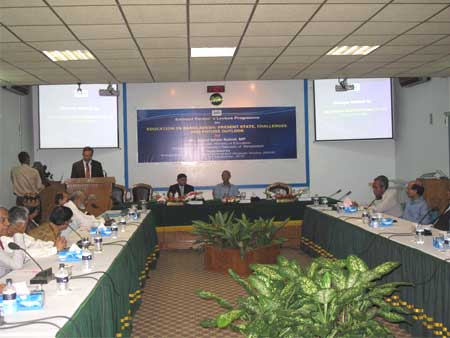
The Bangladesh Institute of
International and Strategic Studies (BIISS) organised a lecture under its Eminent
Persons Lecture Programme (EPLP) titled "Education in Bangladesh:
Present State, Challenges and Future Outlook" on 21 September 2010
at the BIISS Auditorium.
The lecture was delivered by Mr
Nurul Islam Nahid, MP, Honourable Minister, Ministry of Education,
Government of the People's Republic of Bangladesh, as the Guest Speaker.
Major General Golam Mohammad, nwc, psc, Director General of BIISS,
delivered the welcome address, while Major General Muhammed Firdaus Mian,
psc, Chairman of the Board of Governors, BIISS, chaired the session.
The programme brought together
senior government officials, members of the diplomatic corps, policymakers,
academics, researchers, educationists, representatives of civil society,
business leaders, media professionals, and students to discuss the achievements,
challenges, and future priorities of Bangladesh's education sector.
In his lecture, Mr Nurul Islam
Nahid presented a comprehensive overview of the state of education in
Bangladesh, highlighting the progress made in expanding access to education,
increasing enrolment rates, reducing gender disparities, and improving literacy
across the country. He noted that education remains a fundamental driver of
national development and human capital formation, playing a vital role in
poverty reduction, economic growth, and social transformation.
The Guest Speaker also discussed
the major challenges confronting the education sector, including improving the
quality of education, strengthening teacher training, modernising curricula,
enhancing technical and vocational education, expanding higher education
opportunities, integrating information and communication technology (ICT), and
ensuring equitable access to quality education for all. He emphasised that
sustained investment in education and effective policy implementation are
essential for preparing Bangladesh's youth to meet the demands of a rapidly
changing global economy.
Mr Nahid further outlined the
government's future vision for educational reform, focusing on developing a
knowledge-based society through innovation, skills development, research,
digital learning, and institutional capacity building. He stressed the importance
of collaboration among government institutions, educational organisations, the
private sector, civil society, and development partners to achieve inclusive,
quality education and support Bangladesh's long-term socio-economic
development.
The lecture was followed by an
engaging interactive question-and-answer session, during which
participants from academia, the media, government agencies, diplomatic
missions, business communities, civil society organisations, and other
professional groups actively exchanged views with the Guest Speaker. The
discussion generated valuable questions, comments, suggestions, and
recommendations on education policy, governance, quality assurance, human
resource development, and future reform priorities.
The programme concluded with a
reaffirmation of the critical role of education in achieving sustainable
national development and building a skilled, innovative, and inclusive society.
The lecture provided an important platform for informed dialogue on Bangladesh's
education sector and reinforced BIISS's commitment to promoting discussions on
key national policy issues through its Eminent Persons Lecture Programme.