
Bangladesh Institute of International and Strategic Studies
Bangladesh Institute of International and Strategic Studies
Russia’s foreign policy and evolving Bangladesh–Russia cooperation.
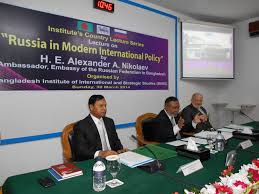
The Bangladesh Institute of International and Strategic Studies (BIISS) organised a Country Lecture Series titled "Russia in Modern International Politics" on 17 March 2014 at the BIISS Auditorium.
The lecture was delivered by H.
E. Mr Alexander A. Nikolaev, Ambassador Extraordinary and Plenipotentiary
of the Russian Federation to the People's Republic of Bangladesh, as the Guest
Speaker. The programme brought together senior government officials,
members of the diplomatic corps, policymakers, academics, researchers, military
officials, representatives of think tanks, media professionals, and students to
discuss Russia's role in the evolving international system and its implications
for global and regional politics.
In his lecture, Ambassador
Alexander A. Nikolaev provided an overview of Russia's foreign policy
priorities and its position in the contemporary international order. He
emphasised Russia's commitment to promoting a multipolar world,
strengthening the role of international law, and enhancing multilateral
cooperation in addressing global political, economic, and security challenges.
He noted that dialogue, mutual respect, and peaceful cooperation remain
fundamental principles of Russia's foreign policy.
The Guest Speaker highlighted
Russia's engagement in global governance, international security, energy
cooperation, counter-terrorism, and regional stability. He discussed the
growing importance of Eurasia and the Asia-Pacific region in global affairs and
stressed the need for constructive international partnerships to address
emerging challenges, including economic uncertainty, transnational crime,
climate change, and technological transformation.
The lecture also explored the
longstanding and friendly relations between Bangladesh and the Russian
Federation, highlighting cooperation in energy, trade, science and
technology, education, defence, and infrastructure development. The Ambassador
reaffirmed Russia's commitment to strengthening bilateral relations and
expanding collaboration in areas of mutual interest, particularly in support of
Bangladesh's socio-economic development.
Participants engaged actively in
the interactive discussion session by raising questions and sharing valuable
comments, suggestions, and observations on Russia's foreign policy,
contemporary geopolitical developments, and the future prospects of Bangladesh–Russia
relations. The exchange of views contributed to a deeper understanding of
Russia's strategic outlook and its role in maintaining international peace and
security.
The programme concluded with a
reaffirmation of the importance of dialogue, mutual understanding, and
international cooperation in addressing contemporary global challenges. The
lecture provided an important platform for informed discussion on Russia's role
in modern international politics and reinforced BIISS's commitment to promoting
scholarly engagement on issues of regional and global strategic significance.