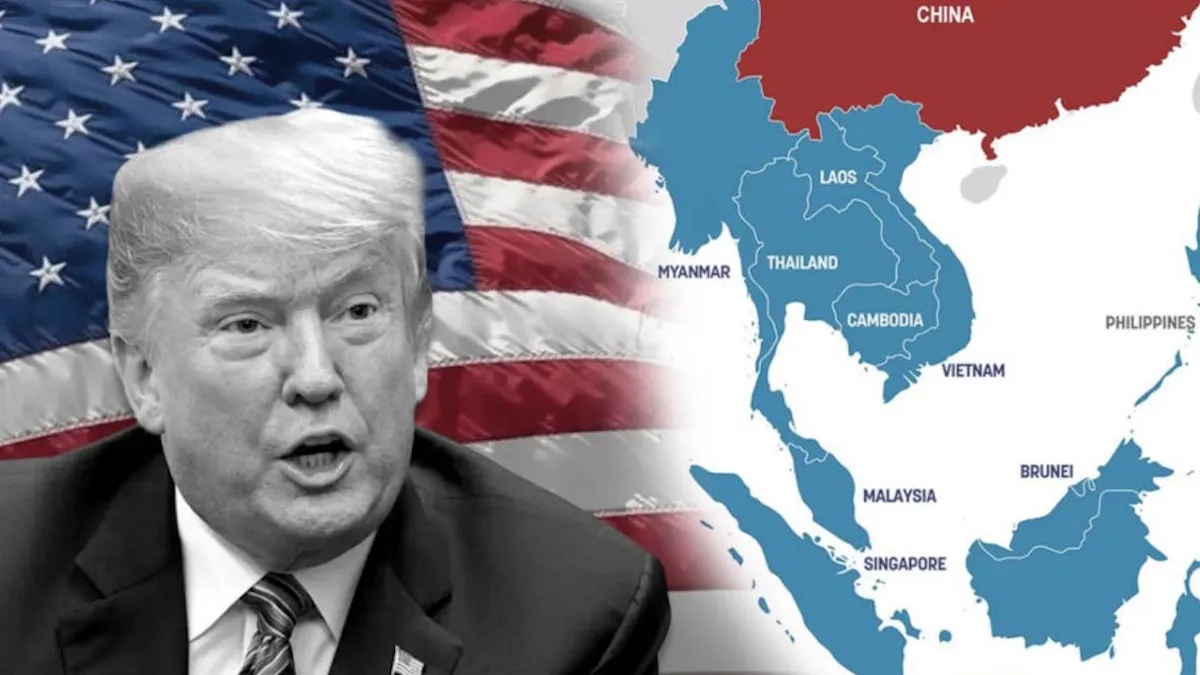
Trump’s Visit TO SOUTHEAST and East Asia: Outcomes and Implications
POLICY ANALYSIS | INDO-PACIFIC AFFAIRS
In the final week
of October, President Donald Trump completed a five-day swing through Southeast
and East Asia, visiting Malaysia, Japan, and South Korea before a closely
watched bilateral meeting with Chinese President Xi Jinping. The trip was
framed around two objectives: reasserting US interest in the Indo-Pacific as a
counterweight to Chinese influence, and securing trade commitments that could
be presented as concrete domestic wins. On at least two of those three counts,
the visit delivered. It can also be
noted that advancing Trump’s bid for a Nobel Peace Prize was among the agenda, as
he also presided over a treaty aimed at easing border tensions between Thailand
and Cambodia, part of his initiatives to portray himself as a peacemaker. What the
visit also revealed, however, is the shape of a US foreign policy architecture
that is transactional by design, and the significant adjustments that
architecture is forcing upon allies and competitors alike.
The economic
outcomes were substantive. Trade agreements were reached with Malaysia and
Cambodia, and frameworks established with Thailand and Vietnam, with tariff
rates for all four set in the range of 19 to 20 per cent. Notably, each
agreement includes provisions targeting third-country trade practices- a
mechanism widely understood as an instrument for reducing Chinese economic
leverage in the region. In Japan, newly elected Prime Minister Sanai Takaichi
pledged $550 billion in Japanese investments in the United States, covering
energy, technology, and semiconductor supply chain priorities. South Korea, for
its part, committed to $200 billion in US-directed investment over ten years,
in exchange for a reduction in its tariff rate from 25 to 15 per cent, and
announced the procurement of nuclear-powered submarines to be built in American
shipyards. These are not incidental outcomes. They reflect a deliberate US
strategy of converting alliance relationships into quantifiable economic
commitments. These results will help Trump appease the domestic audience and
highlight his aims to keep America winning.
The Trump–Xi
meeting stood apart in register and implication. Where the broader tour was
characterised by ceremony and bilateral warmth, the meeting with Xi was notably
formal. The substantive outcome: a trade war truce in which the US suspended
expanded restrictions for one year, China eased access to critical minerals,
and pledged to resume agricultural imports and increase purchases of US energy.
These outcomes represent a significant, if provisional, stabilisation of the
world’s most consequential bilateral relationship. The agreement preserves a
crucial diplomatic guardrail and signals that, despite the structural tensions
of great-power competition, both Washington and Beijing retain an interest in
managed engagement over open confrontation.
Critical minerals
have emerged as the defining material contest of the current strategic
environment. Their centrality to the trade truce with China, and their implicit
presence in the semiconductor and technology provisions of the Southeast Asian
agreements, confirms that the resource competition underpinning the US–China
rivalry has moved from background condition to front-line policy priority.
Whichever power secures reliable access to and processing capacity for these
materials will hold a structural advantage in the technology and defence
sectors for the foreseeable future.

China’s posture
throughout the period of Trump’s visit warrants equal attention. Xi had toured
Southeast Asia in April; Trump’s visit was explicitly understood as a
counter-move. Yet Trump’s decision to skip both the ASEAN Summit and the APEC
leaders’ meeting, forums that Chinese
leadership attended in full, reinforced the perception of an erratic US
presence in regional multilateral architecture. Beijing has consistently
positioned itself as a stable and predictable partner in contrast to
Washington’s volatility. The pattern of US absence from institutional settings,
even during an ostensibly re-engagement-focused tour, provides China with
precisely the narrative it seeks to cultivate across the Global South and the
Indo-Pacific.
For US allies in
the region, the trip clarifies rather than resolves a central dilemma. Japan
and South Korea are both accelerating defence spending, South Korea by 8.2
percent in the coming year, Japan moving to meet a 2 percent of GDP target
ahead of schedule, in direct response to Washington’s expectation that allies
bear a greater share of their own security burden. Southeast Asian states,
meanwhile, continue to pursue strategic hedging, unwilling to formally align
with either Washington or Beijing, given their deep economic entanglement with
both. Whether Trump’s visit marks the beginning of a more sustained US
diplomatic engagement in the Indo-Pacific, or constitutes a transactional
episode with limited institutional follow-through, remains the central open
question for regional policymakers — including those in Dhaka.