
Bangladesh Institute of International and Strategic Studies
Bangladesh Institute of International and Strategic Studies
Challenges and Future Directions on 14 August 2012
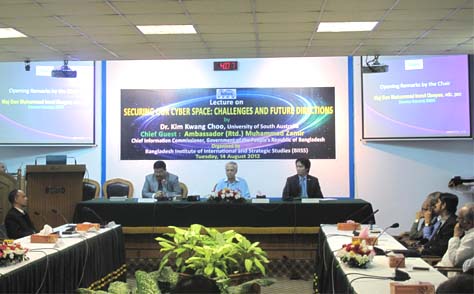
The Bangladesh Institute of
International and Strategic Studies (BIISS) organised a lecture titled "Securing
Cyberspace: Challenges and Future Directions" on 13 August 2012
at the BIISS Auditorium.
The lecture was delivered by Dr
Kim Kwang Cho, Professor of Computer Science and Engineering at Korea
University, as the Guest Speaker. The programme was graced by H.
E. Dr Dipu Moni, MP, Honourable Minister of Foreign Affairs, Government of
the People's Republic of Bangladesh, as the Chief Guest. Ambassador
(Retd.) Muhammad Zamir, Chairman of the Board of Governors, BIISS,
inaugurated the programme and delivered the opening remarks.
The lecture brought together
senior government officials, members of the diplomatic corps, policymakers,
academics, researchers, military officials, representatives of law enforcement
agencies, information technology professionals, think tanks, media, and
students to discuss the emerging challenges of cybersecurity and the future of
cyberspace governance.
In his lecture, Professor Kim
Kwang Cho highlighted the rapid expansion of cyberspace and its growing
importance in national development, economic growth, and international
security. He discussed the increasing sophistication of cyber threats,
including cybercrime, hacking, cyber espionage, identity theft, malware, and
attacks on critical information infrastructure. He emphasised that
cybersecurity has become a vital component of national security and requires
continuous innovation, international cooperation, and effective policy
responses.
The Guest Speaker stressed the
importance of developing robust cybersecurity frameworks, strengthening legal
and regulatory mechanisms, enhancing cyber resilience, and investing in
advanced technologies to protect digital infrastructure. He also underscored
the need for public awareness, skilled human resources, and close collaboration
among governments, academia, the private sector, and international partners to
effectively combat evolving cyber threats.
The lecture further explored the
opportunities and challenges associated with the increasing digitalisation of
societies. Participants discussed issues relating to information security,
cyber governance, data protection, digital privacy, cyber diplomacy, and
international norms for responsible state behaviour in cyberspace. The
discussion highlighted the importance of balancing technological advancement
with security, privacy, and the protection of fundamental rights.
The programme concluded with an
interactive discussion session during which participants shared valuable
questions, comments, suggestions, and observations on emerging cybersecurity
challenges and strategies for building a secure and resilient digital environment.
The event reaffirmed the importance of international cooperation, capacity
building, and technological innovation in addressing cyber threats and
strengthening cybersecurity for sustainable development and global security.