
Bangladesh Institute of International and Strategic Studies
Bangladesh Institute of International and Strategic Studies
Lessons from Sri Lanka" on 23 May 2017
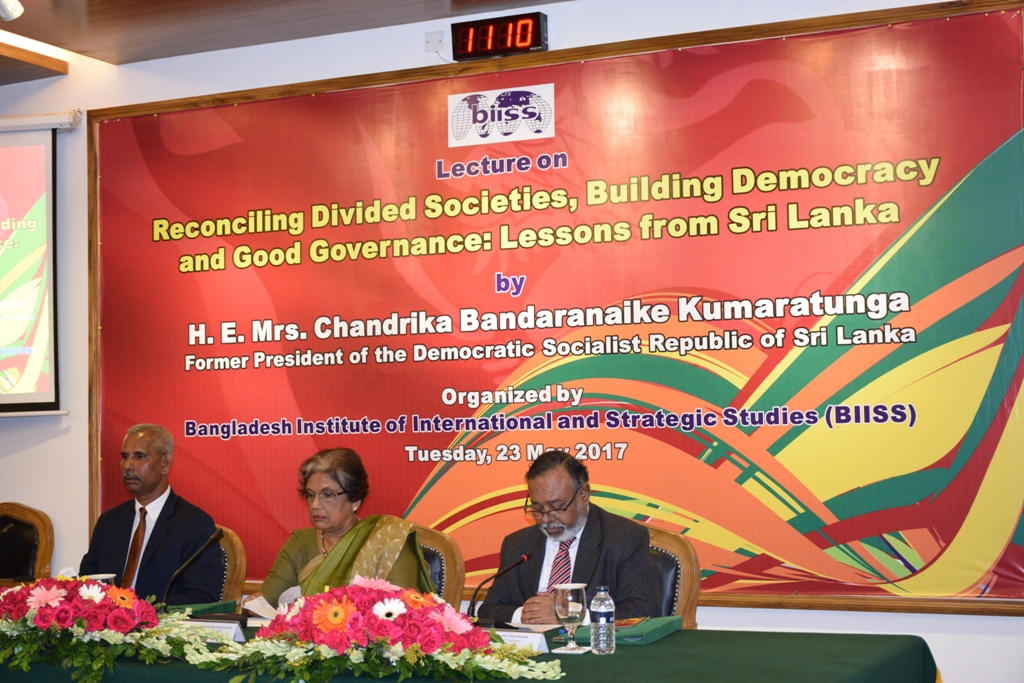
The Bangladesh Institute of
International and Strategic Studies (BIISS) organised a lecture titled "Reconciling
Divided Societies, Building Democracy and Good Governance: Lessons from Sri
Lanka" on 23 May 2017 at the BIISS Auditorium in Dhaka.
H. E. Mrs Chandrika
Bandaranaike Kumaratunga, former President of the Democratic Socialist
Republic of Sri Lanka and Member of the Global Leadership Foundation,
delivered the lecture as the Guest Speaker. Major General A K M Abdur
Rahman, ndc, psc, Director General of BIISS, delivered the welcome address,
while Ambassador Munshi Faiz Ahmad, Chairman of the Board of Governors,
BIISS, chaired the session and delivered the closing remarks.
In her lecture, Mrs
Kumaratunga shared Sri Lanka's experiences in post-conflict reconciliation,
democratic consolidation, and the promotion of good governance following the
country's prolonged civil conflict. Drawing upon her leadership experience, she
discussed the complex challenges of rebuilding trust among divided communities
and highlighted the importance of inclusive political processes, institutional
reforms, and national dialogue in achieving lasting peace and stability.
The Guest Speaker reflected on
the devastating consequences of nearly three decades of terrorism and armed
conflict in Sri Lanka, describing terrorism as one of the most dehumanising and
politically destabilising phenomena in South Asia. She emphasised that
sustainable peace cannot be achieved solely through security measures, but
requires addressing the underlying causes of violent extremism, including
social marginalisation, economic deprivation, political exclusion, and
inequality. According to her, effective reconciliation must be based on
justice, equal opportunities, respect for diversity, and the protection of
human rights.
Mrs Kumaratunga also highlighted
the indispensable role of democracy, good governance, and the rule of law in
fostering national unity and preventing future conflicts. She underscored the
importance of accountable institutions, transparency, public participation, and
inclusive development in building resilient societies capable of overcoming
historical divisions. She further stressed that education, youth empowerment,
and community engagement are vital components of long-term peacebuilding and
democratic resilience.
The programme was attended by
senior government officials, members of the diplomatic corps, policymakers,
academics, researchers, military officials, representatives of think tanks,
media professionals, students from various universities, and representatives of
international organisations. During the interactive discussion session,
participants raised thoughtful questions and shared valuable comments,
suggestions, and observations on post-conflict reconciliation, democratic
governance, countering violent extremism, and regional peacebuilding.
The event concluded with a
reaffirmation of the importance of inclusive governance, dialogue, and
reconciliation in addressing contemporary security challenges and promoting
sustainable peace. The lecture provided valuable insights into Sri Lanka's
post-conflict experience and offered important lessons for policymakers,
researchers, and practitioners engaged in peacebuilding, democratic governance,
and conflict resolution.