
Bangladesh Institute of International and Strategic Studies
Bangladesh Institute of International and Strategic Studies
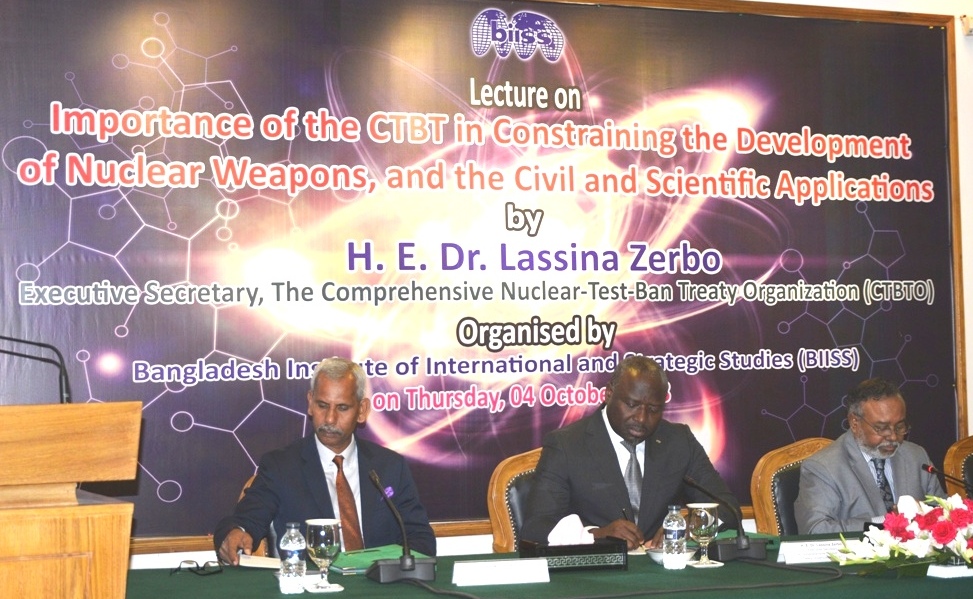
The Bangladesh Institute of
International and Strategic Studies (BIISS) organised a lecture titled "Importance
of the CTBT in Constraining the Development of Nuclear Weapons, and the Civil
and Scientific Applications" on 04 October 2018 at the BIISS
Auditorium.
H. E. Dr Lassina Zerbo,
Executive Secretary of the Comprehensive Nuclear-Test-Ban Treaty
Organization (CTBTO), delivered the lecture as the Guest Speaker. Major
General A K M Abdur Rahman, ndc, psc, Director General of BIISS, delivered
the welcome address, while Ambassador Munshi Faiz Ahmad, Chairman of the
Board of Governors, BIISS, chaired the session and delivered the concluding
remarks.
In his lecture, Dr Lassina
Zerbo underscored the critical importance of the Comprehensive
Nuclear-Test-Ban Treaty (CTBT) in strengthening the global nuclear
non-proliferation and disarmament regime. He explained that the Treaty
prohibits all nuclear weapon test explosions and any other nuclear explosions,
thereby serving as a cornerstone of international efforts to prevent the
development and qualitative improvement of nuclear weapons. He stressed that
the entry into force of a legally binding CTBT remains an essential step
towards achieving the shared vision of a world free of nuclear weapons.
The Guest Speaker highlighted the
advanced global verification regime established by the CTBTO, including the International
Monitoring System (IMS), which enables the detection of nuclear explosions
anywhere in the world. He also discussed the organisation's technical
capabilities and reaffirmed the CTBTO's readiness to assist member states in
supporting verifiable nuclear disarmament and non-proliferation initiatives
whenever required.
Dr Zerbo further emphasised the civilian
and scientific applications of CTBT monitoring technologies. He explained
that the International Monitoring System contributes significantly to disaster
risk reduction, tsunami early warning, earthquake monitoring, volcanic eruption
detection, atmospheric research, and other scientific endeavours that benefit
humanity beyond the Treaty’s core verification mission.
Commending Bangladesh's
longstanding commitment to global peace and nuclear disarmament, Dr Zerbo noted
that Bangladesh has been a strong advocate of general and complete
disarmament and nuclear non-proliferation. He recalled that
Bangladesh was among the first group of signatories to the CTBT and became the 54th
country to ratify the Treaty on 8 March 2000, demonstrating its enduring
commitment to international peace, security, and multilateral cooperation.
The programme was attended by
senior government officials, members of the diplomatic corps, policymakers,
academics, researchers, military officials, representatives of international
organisations, think tanks, media, and students from various universities.
During the interactive discussion session, participants exchanged valuable
questions, comments, suggestions, and observations on nuclear disarmament, arms
control, international security, and the peaceful applications of CTBT
technologies.
The event concluded with a
reaffirmation of the international community's shared responsibility to
strengthen the global nuclear non-proliferation regime and advance the
objectives of the CTBT through sustained multilateral cooperation, scientific
innovation, and collective commitment to international peace and security.