
Bangladesh Institute of International and Strategic Studies
Bangladesh Institute of International and Strategic Studies
A South Asian Perspective" on 06 August 2012
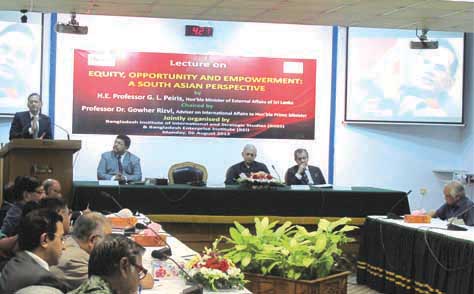
The Bangladesh Institute of
International and Strategic Studies (BIISS), in collaboration with the Bangladesh
Enterprise Institute (BEI), jointly organised a lecture titled "Equity,
Opportunity and Empowerment: A South Asian Perspective" on 06
August 2012 at the BIISS Auditorium.
The lecture was delivered by Hon'ble
Professor G. L. Peiris, Minister of External Affairs of the Democratic
Socialist Republic of Sri Lanka, as the Guest Speaker. Professor Dr
Gowher Rizvi, International Affairs Adviser to the Honourable Prime
Minister of Bangladesh, presided over the session. The welcome addresses were
delivered by Major General Muhammad Imrul Quayes, ndc, psc, Director
General of BIISS, and Ambassador Farooq Sobhan, President of the
Bangladesh Enterprise Institute (BEI).
The programme brought together
senior government officials, members of the diplomatic corps, policymakers,
academics, researchers, military officials, representatives of international
organisations, think tanks, professional bodies, media, and students to discuss
issues relating to equitable development, regional cooperation, and inclusive
growth in South Asia.
In his lecture, Professor G.
L. Peiris examined the concepts of equity, opportunity, and empowerment
as essential pillars of sustainable development and social progress in South
Asia. He emphasised that economic growth alone cannot ensure lasting prosperity
unless it is accompanied by social justice, equal opportunities, good
governance, and inclusive public policies that enable all segments of society
to participate in national development.
The Guest Speaker highlighted the
importance of strengthening democratic institutions, enhancing access to
education and healthcare, promoting gender equality, reducing poverty, and
creating opportunities for youth and marginalised communities. He observed that
South Asian countries face many common challenges, including inequality,
unemployment, climate vulnerability, and governance deficits, which require
collaborative regional responses and stronger policy coordination.
Professor Peiris also underscored
the significance of regional cooperation in accelerating economic
integration, expanding trade and investment, improving connectivity, and
fostering people-to-people exchanges. He stressed that greater collaboration
among South Asian countries would contribute to peace, stability, and shared prosperity
while enabling the region to better address emerging global challenges.
Following the lecture, an
engaging interactive discussion session was held in which distinguished
scholars, academics, representatives of multidisciplinary professional
organisations, members of the diplomatic community, government and
non-government officials, policymakers, and researchers actively participated.
The participants enriched the discussion by raising insightful questions and
offering valuable comments, suggestions, and recommendations on inclusive
development, regional integration, and the future of South Asian cooperation.
The programme concluded with a
reaffirmation of the importance of equitable growth, social inclusion, and
regional partnership in achieving sustainable development. The lecture provided
an important platform for exchanging ideas on the challenges and opportunities
facing South Asia and reinforced BIISS's commitment to promoting informed
dialogue on issues of regional and international significance.