
Bangladesh Institute of International and Strategic Studies
Bangladesh Institute of International and Strategic Studies
Bangladesh–Japan development cooperation & BIG-B driven connectivity.
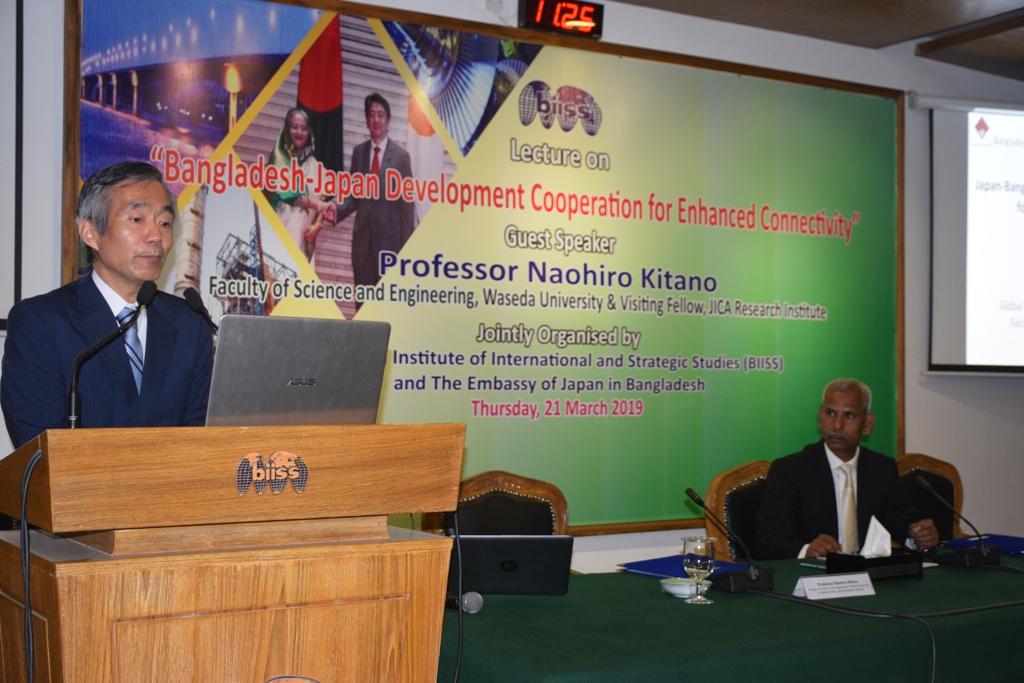
The Bangladesh Institute of
International and Strategic Studies (BIISS), in collaboration with the Embassy
of Japan in Bangladesh, organised a lecture titled "Bangladesh–Japan
Development Cooperation for Enhanced Connectivity" on 21 March 2019
at the BIISS Auditorium.
The lecture featured Professor
Naohiro Kitano, Faculty of Science and Engineering, Waseda University and
Visiting Fellow, JICA Research Institute, as the Guest Speaker. The
programme brought together senior government officials, members of the
diplomatic corps, policymakers, academics, researchers, military officials,
representatives of development organisations, think tanks, media, and students
to discuss the evolving partnership between Bangladesh and Japan, with
particular emphasis on development cooperation and regional connectivity.
In his lecture, Professor
Naohiro Kitano highlighted the longstanding friendship between Bangladesh
and Japan, describing Japan as one of Bangladesh's most trusted development
partners. He reviewed the evolution of bilateral development cooperation over
the decades and underscored Japan's significant contributions to Bangladesh's
socio-economic transformation through Official Development Assistance (ODA),
infrastructure development, human resource development, and technology
transfer.
The Guest Speaker emphasised that
enhanced connectivity is fundamental to achieving sustainable economic growth
and regional integration. He discussed Japan's support for major infrastructure
projects in Bangladesh, including transport networks, ports, energy, urban
development, and industrial infrastructure, which are expected to improve
domestic and regional connectivity, facilitate trade and investment, and
strengthen Bangladesh's role as a regional economic hub.
The lecture also highlighted the
importance of the Bay of Bengal Industrial Growth Belt (BIG-B) Initiative
and other connectivity-oriented development programmes in fostering inclusive
economic development. The speaker stressed that improved physical, economic,
and institutional connectivity would create new opportunities for trade,
investment, industrialisation, logistics, and people-to-people exchanges,
thereby contributing to prosperity across the region.
Participants also discussed
prospects for expanding Bangladesh–Japan cooperation in areas such as smart
infrastructure, digital transformation, innovation, disaster risk reduction,
climate resilience, renewable energy, higher education, and capacity building.
The discussion underscored the importance of strengthening public-private
partnerships and promoting sustainable, high-quality infrastructure development
aligned with Bangladesh's long-term development aspirations.
The programme concluded with an
interactive discussion session during which participants exchanged valuable
questions, comments, suggestions, and observations on the future of
Bangladesh–Japan development cooperation. The event reaffirmed the shared commitment
of Bangladesh and Japan to deepening their strategic partnership through
enhanced connectivity, sustainable infrastructure development, economic
cooperation, and regional integration.