
Bangladesh Institute of International and Strategic Studies
Bangladesh Institute of International and Strategic Studies
Prospect for Sub-Regional Cooperation" on 18 February 2020
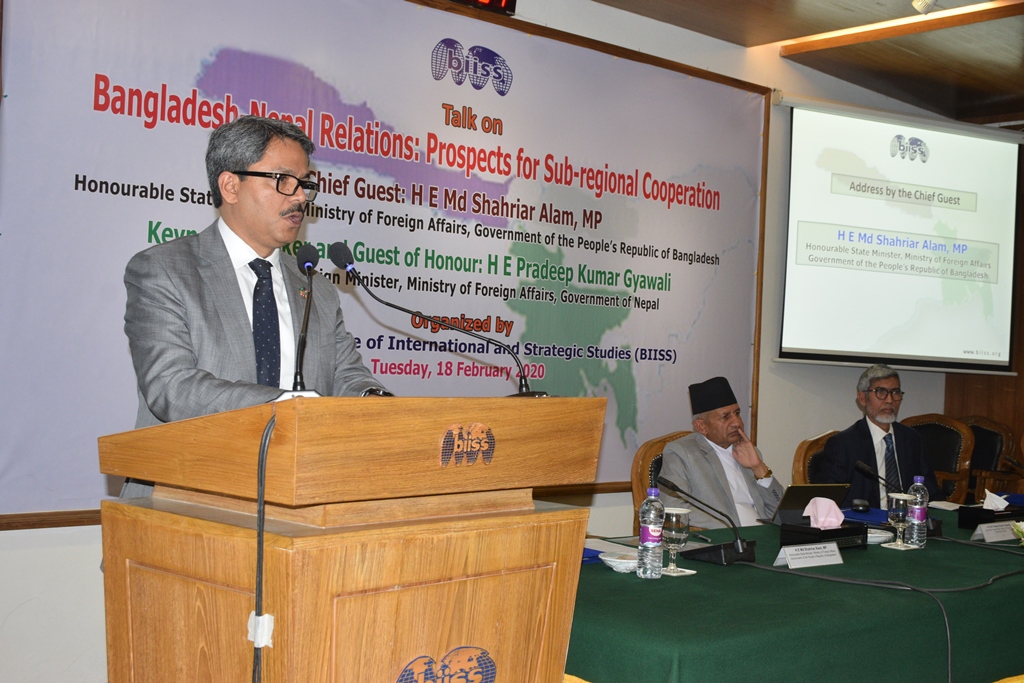
The Bangladesh Institute of
International and Strategic Studies (BIISS) organised a talk titled "Bangladesh–Nepal
Relations: Prospect for Sub-Regional Cooperation" on 18 February
2020 at the BIISS Auditorium.
H. E. Md Shahriar Alam, MP,
Honourable State Minister, Ministry of Foreign Affairs, Government of the
People's Republic of Bangladesh, attended the programme as the Chief Guest,
while H. E. Mr Pradeep Kumar Gyawali, Honourable Minister for Foreign
Affairs of the Government of Nepal, delivered the keynote address and graced
the event as the Guest of Honour. The session was chaired by Ambassador
M Fazlul Karim, Chairman of BIISS, who also delivered the welcome address.
In his keynote lecture, H. E.
Mr Pradeep Kumar Gyawali described Bangladesh and Nepal as "closer
friends than neighbours," emphasising that the two countries are bound
together by geographical proximity, shared cultural heritage, common values,
and enduring people-to-people ties. He noted that the teachings of Lord
Buddha and the literary legacy of Rabindranath Tagore have
strengthened the spiritual, cultural, and emotional bonds between the two
nations. He further observed that the rivers originating from the Himalayas
have played a vital role in nurturing the fertile plains of Bangladesh,
symbolising the deep natural and civilisational linkages shared by both
countries.
Highlighting the prospects for
bilateral and sub-regional cooperation, the Nepalese Foreign Minister
underscored the vast untapped potential for expanding trade, investment,
tourism, energy cooperation, and cross-border connectivity. While acknowledging
that bilateral trade remained below its potential, he stressed that enhanced
transport and transit links, improved market access, and greater private sector
engagement could significantly strengthen economic relations between the two
countries.
The discussions also focused on
the importance of sub-regional cooperation under initiatives such as the Bangladesh-Bhutan-India-Nepal
(BBIN) framework. Speakers highlighted the need to accelerate cooperation
in multimodal connectivity, hydropower development, renewable energy, trade
facilitation, regional value chains, and sustainable tourism. They emphasised
that closer collaboration among South Asian neighbours would contribute to
regional integration, shared prosperity, and sustainable development.
The programme was attended by
senior government officials, members of the diplomatic corps, policymakers,
academics, researchers, military officials, representatives of think tanks,
media professionals, students from various universities, and representatives of
international organisations. During the interactive discussion session,
participants shared valuable questions, comments, suggestions, and observations
on strengthening Bangladesh–Nepal relations and advancing sub-regional
cooperation in South Asia.
The event concluded with a
reaffirmation of the longstanding friendship between Bangladesh and Nepal and
the shared commitment of both countries to deepening bilateral engagement and
promoting greater regional connectivity, economic cooperation, and people-to-people
exchanges for mutual prosperity and regional stability.