
Bangladesh Institute of International and Strategic Studies
Bangladesh Institute of International and Strategic Studies

BOOK 1: BANGLADESH AND THE LIBERAL DEMOCRATIC MODEL
PREFACE | v
PROLOG: Political Dimensions of Independence: Asian
Leaders and the Liberal Democratic Model of Government and Politics | ix
ONE: Ten Years of Ayub Khan and the Problem of
National Integration | 1
TWO: Elite in Crisis: The Failure of
Mujib-Yahya-Bhutto Negotiations | 26
THREE: Reflections on the National Liberation Movement
and Some Post Liberation Priorities in Bangladesh | 53
FOUR: Bangladesh in 1972: Nation Building in a New
State | 63
FIVE: Bangladesh in 1973: Management of Factional
Politics | 79
SIX: Bangladesh: Constitutional Experimentation in the
Aftermath of Liberation | 93
SEVEN: Bangabandhu and After: Conflict and Change in
Bangladesh | 128
EIGHT: Members of Parliament in Bangladesh | 143
NINE: The Context of Electoral Participation in
Bangladesh: Social Organization and Political Tradition | 161
TEN: The 1973 National Election in Bangladesh: An
Analysis of Partisanship in Two Constituencies | 172
ELEVEN: The Zia Regime: Once Again At the Starting
Point | 197
INDEX | 221
BOOK 2: THE UNION OF COMMUNIST YOUTH IN ROMANIA
Foreword | 9
I. THE UNION OF COMMUNIST YOUTH — THE POLITICAL
REVOLUTIONARY ORGANIZATION OF THE YOUTH IN ROMANIA, RELIABLE SUPPORT OF THE
PARTY IN THE COMMUNIST EDUCATION OF YOUTH | 13
II. YOUTH — AN ACTIVE FACTOR IN THE BUILDING OF THE
MULTILATERALLY DEVELOPED SOCIALIST SOCIETY AND ROMANIA’S ADVANCE TOWARDS
COMMUNISM | 47
[Section III Continued]
3. The Education of Youth in the Spirit of Socialist
Patriotism, of Friendship and Brotherhood of All Working People, Irrespective
of Nationality | 143
4. The U.C.Y. Members, All Youth Must Work and Live in
Accordance with the Provisions of the Code of the Principles and Norms of Work
and Life of the Communists, of the Socialist Ethics and Equity | 164
5. The Cultural, Educational and Sports Activity — an
Inseparable Part of the Work of Shaping the New-type Man with a Progressive
Conception, Active Participant in the Building of the Multilaterally Developed
Socialist Society and of Communism | 169
6. Radio, Television, Arts and Literature, Besides
Other Factors, Have Greater Tasks in the Work of Educating the Youth | 183
IV. THE YOUTH ORGANIZATIONS OF ROMANIA CONSISTENTLY
PROMOTE THE FOREIGN POLICY OF THE PARTY AND STATE | 193
Index of Bibliographic Sources from the Work of
Romania’s President, Nicolae Ceausescu | 225
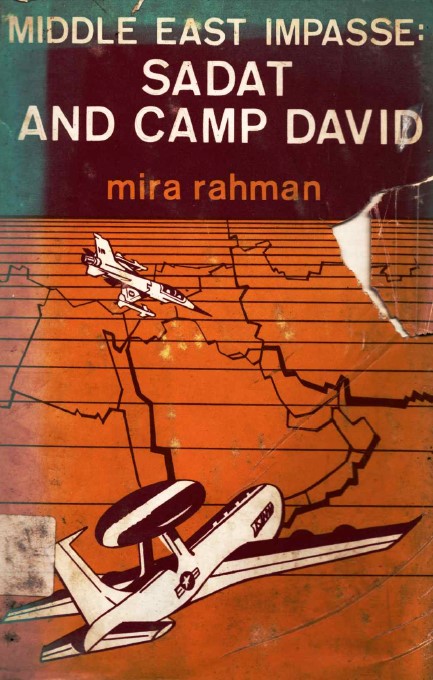
BOOK 3: SUPER POWER RIVALRY AND CAMP DAVID
Foreword | viii
Preface | ix
Acknowledgements | xi
Chapter I: Introduction | 1
Chapter II: Super Power Rivalry: | 14
(i) Historical Perspective
(ii) From Bipolarity to Détente
Chapter III: Egypt under Anwar-el-Sadat: | 23
(i) Emergence of Sadat after Nasser
(ii) Sadat’s Policy Approach
Chapter IV: Super Power Rivalry despite Détente since
the Seventies: | 36
(i) Change in American Global Strategy in the 70’s
(ii) The Russian Moves
Chapter V: Sadat and Camp David: | 52
(i) Sadat’s Initiative Towards Peace
(ii) The Camp David Accord
(iii) Analysis of the Various Aspects of the Treaty
(iv) Secret Accord in Camp David
(v) Economic Benefits
(vi) Concluding Observations on Camp David
Chapter VI: Reaction to Camp David and Subsequent
Developments: | 69
(i) Reaction in West European Countries
(ii) The Japanese Reaction
(iii) The Chinese Position
(iv) Peace Treaty between Egypt and Israel
(v) Arab Failure to Respond Unitedly
(vi) Super Power Confrontation as affecting
Arab-Israeli Conflict
(vii) Israel’s Hardline
(viii) Major Internal Developments in Egypt
Chapter VII: Conclusion | 101
MAPS:
Map 1: Israel’s plan for acquiring Arab territory,
1971 | 117
Map 2: Arrangements for Sinai under Treaty of Peace
between Egypt and Israel | 118
ANNEXURES:
Annexure I: Population Size, Oil Production and
Military Strength of some of the Middle Eastern Countries | 119
Annexure II: Text of Agreements signed at Camp David
on September 17, 1978:
(a) A Framework for Peace in the Middle East agreed at
Camp David | 120
(b) Framework for the conclusion of a Peace Treaty
between Egypt and Israel | 130
Annexure III: Letters exchanged at Camp David:
(a) A letter addressed by Begin to President Carter at
Camp David
(b) A letter addressed by Sadat to President Carter at
Camp David
(c) A letter addressed to Begin by President Carter at
Camp David
(d) A letter addressed to Sadat by President Carter at
Camp David
Annexure IV: General Assembly Resolutions 3236 and
3237 | 133
Annexure V: Text of United Nations Security Council
Resolution 242 of November 22, 1967 | 134
Annexure VI: Text of United Nations Security Council
Resolution 338 of October 22, 1973 | 136
Annexure VII: Treaty of Peace between the Arab
Republic of Egypt and the State of Israel | 137
Annexure VIII: Agreed Minutes to Articles I, IV, V and
VI and Annexure I and III of the Treaty of Peace | 155
Annexure IX: Resolution 465 (1980)—adopted by the
Security Council at its 2203D Meeting on March 1, 1980 | 158
Bibliography | 161
Index | 166
